India’s renewable energy transition has entered a decisive phase as the country aggressively pushes toward its ambitious target of achieving 500 gigawatts (GW) of non-fossil fuel energy capacity by 2030. At the centre of this transformation stands Adani Green Energy Ltd (AGEL), one of the country’s largest renewable energy companies, which has rapidly expanded its solar and wind power portfolio at an unprecedented scale.
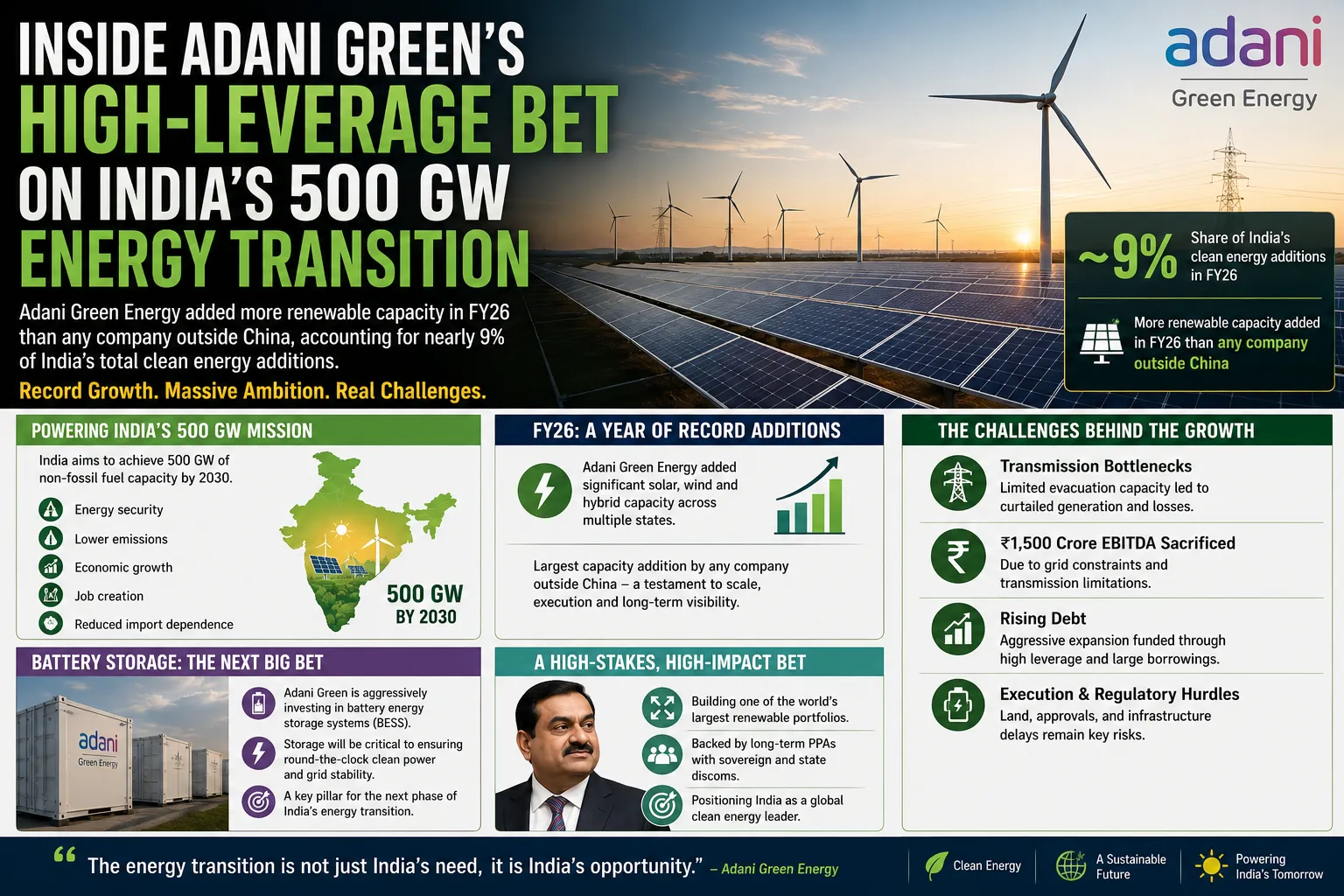
During FY26, Adani Green reportedly added more renewable capacity than any company outside China, accounting for nearly 9% of India’s total clean energy additions during the period. The achievement reinforced the company’s position as a dominant force in India’s clean energy landscape and highlighted the sheer pace at which the country’s renewable infrastructure is evolving.
However, behind the impressive expansion lies a much more complex financial and operational story. Adani Green’s aggressive growth strategy is heavily dependent on large-scale borrowing, rapid infrastructure execution, transmission connectivity, battery storage investment, and long-term confidence in India’s energy demand growth.
The company’s journey now reflects the broader challenges facing India’s renewable sector itself: balancing rapid clean energy expansion with financial sustainability, grid stability, transmission readiness, and long-term profitability.
Adani Green’s Massive Expansion Strategy
Adani Green’s growth over the past few years has been driven by an aggressive strategy focused on utility-scale solar parks, hybrid renewable projects, wind farms, and emerging energy storage infrastructure.
The company has rapidly expanded operations across multiple Indian states while securing long-term power purchase agreements (PPAs) with government agencies and distribution companies. These agreements provide predictable future revenue streams, which are critical for financing large infrastructure investments.
The scale of Adani Green’s ambition is extraordinary. The company aims to develop one of the world’s largest renewable energy portfolios, with major projects concentrated in regions such as Rajasthan and Gujarat where solar and wind potential remains exceptionally high.
Its massive Khavda renewable energy project in Gujarat has become one of the most closely watched clean-energy developments globally because of its planned scale and integrated infrastructure model.
The company’s rapid expansion also aligns directly with India’s larger geopolitical and economic priorities, including reducing fossil fuel imports, strengthening energy security, and accelerating decarbonisation goals.
India’s 500 GW Renewable Energy Target
India’s renewable energy ambitions are among the most aggressive in the world. The government has committed to achieving 500 GW of non-fossil fuel electricity capacity by 2030 as part of its broader climate commitments and long-term energy transition plans.
Meeting this target requires enormous investment across several sectors, including:
-
Solar power generation
-
Wind energy infrastructure
-
Battery storage systems
-
Transmission networks
-
Grid modernisation
-
Green hydrogen development
-
Electric mobility infrastructure
India’s rapidly growing economy and population continue driving electricity demand higher each year. Renewable energy therefore represents not only an environmental objective but also a strategic economic necessity.
Companies like Adani Green have emerged as central players in this transition because the scale of required investment exceeds what public-sector entities alone can deliver.
The private sector’s role in financing, constructing, and operating renewable infrastructure is expected to remain essential throughout India’s clean-energy transformation.
The Financial Risks Behind Rapid Growth
Despite its record renewable additions, Adani Green’s expansion strategy carries substantial financial risks due to its high leverage model.Renewable energy infrastructure projects require enormous upfront capital investments long before they begin generating stable returns. Companies therefore rely heavily on debt financing to fund construction, land acquisition, transmission integration, and equipment procurement.
Adani Green has consistently raised significant amounts of debt to support its aggressive capacity expansion plans. While long-term renewable projects often generate predictable future cash flows, rising leverage naturally increases financial pressure during periods of market volatility or operational disruption.
Investors and analysts continue closely monitoring the company’s debt levels, refinancing capabilities, and long-term profitability metrics.The challenge becomes even more complicated because renewable energy returns often materialise gradually over many years, while debt servicing obligations begin immediately.
This creates a delicate balancing act between expansion speed and financial sustainability.
Transmission Bottlenecks Remain a Major Challenge
One of the biggest obstacles facing India’s renewable energy sector is transmission infrastructure readiness. Building renewable generation capacity alone is not enough; electricity must also be efficiently transmitted across the country’s grid network.
Several renewable projects across India have experienced delays or underutilisation due to insufficient transmission connectivity. Remote solar and wind farms are often located far from high-demand urban and industrial centres, requiring massive investments in transmission corridors.
Adani Green itself reportedly sacrificed around Rs 1,500 crore in potential EBITDA due to transmission-related constraints affecting renewable power evacuation.
This highlights a growing challenge across India’s energy transition: generation capacity is expanding faster than supporting infrastructure in some regions.
Without adequate grid integration, renewable projects risk operating below full capacity despite substantial capital investment.
The issue also demonstrates that India’s clean-energy transformation requires coordinated expansion not only of renewable generation but also of transmission, storage, and distribution infrastructure.
Battery Storage Is Becoming the Next Big Battleground
One of the most important aspects of Adani Green’s future strategy is its increasing focus on battery energy storage systems (BESS).Battery storage is rapidly emerging as a critical component of modern renewable energy systems because solar and wind generation remain intermittent by nature. Solar energy production falls at night, while wind generation varies based on weather conditions.
Battery storage systems help solve this problem by storing excess renewable electricity during peak generation periods and releasing it later when demand rises or renewable output declines.
Adani Green’s aggressive push into battery storage reflects a broader global shift in energy markets. Future renewable energy leadership may depend not only on generating clean electricity but also on managing storage and grid reliability effectively.
Large-scale battery investments could therefore become one of the defining features of India’s next energy phase.However, battery infrastructure also introduces additional financial pressure because storage technologies remain expensive and require significant long-term investment.
The Economics of Renewable Energy Are Changing
India’s renewable sector has evolved dramatically over the last decade. Earlier renewable projects primarily focused on capacity expansion and government incentives. Today, the industry is becoming increasingly competitive, technologically advanced, and financially sophisticated.
Solar panel prices, wind turbine efficiency, and storage technologies have improved substantially, making renewable energy more economically viable than ever before.
At the same time, however, profit margins are tightening because companies aggressively compete for large government auctions and power contracts.
This means renewable developers must now focus not only on expansion but also on operational efficiency, financing costs, execution speed, and long-term asset management.
Adani Green’s strategy reflects this changing reality. The company is attempting to build scale rapidly enough to maintain leadership while simultaneously navigating rising debt obligations and evolving market economics.
Its success or failure could influence how other renewable companies approach expansion in India.
Global Investors Are Closely Watching India’s Energy Transition
India’s renewable energy market has become one of the world’s most attractive investment destinations for global institutional investors, sovereign wealth funds, infrastructure funds, and climate-focused financiers.
The country’s massive electricity demand growth combined with government-backed clean-energy policies creates enormous long-term business potential.
Adani Green has attracted international investor attention because it represents one of the largest pure-play renewable growth stories globally.
However, international investors are also highly sensitive to risks related to:
-
Corporate leverage
-
Regulatory stability
-
Transmission infrastructure
-
Currency fluctuations
-
Power distribution company finances
-
Project execution timelines
As India accelerates its renewable ambitions, investor confidence will increasingly depend on how effectively companies and policymakers manage these structural challenges.
Why Renewable Energy Expansion Is Strategically Important for India
India’s renewable energy push extends far beyond climate commitments. The transition also carries major geopolitical, economic, and national security implications.
India remains heavily dependent on imported fossil fuels, especially crude oil and natural gas. Expanding domestic renewable generation can help reduce import dependence, improve energy security, and stabilise long-term electricity costs.
Renewable infrastructure also supports:
-
Industrial growth
-
Job creation
-
Manufacturing expansion
-
Rural electrification
-
Climate resilience
-
Technological innovation
The energy transition is therefore increasingly viewed as a central pillar of India’s future economic development strategy.
Companies like Adani Green are not simply building power projects; they are becoming part of a much larger national transformation involving infrastructure, manufacturing, technology, and sustainability.
The Risks of Overexpansion
Despite the optimism surrounding India’s clean-energy future, some analysts remain cautious about the risks of extremely rapid expansion financed through heavy borrowing.
Large infrastructure cycles can become vulnerable if economic conditions weaken, financing costs rise sharply, or project execution faces delays.
Renewable energy companies also face regulatory uncertainty related to tariffs, land acquisition, environmental approvals, and state electricity distribution finances.
Battery storage investments, while strategically important, may take years before delivering strong returns due to evolving technology costs and market structures.
Adani Green’s high-growth model therefore represents both enormous opportunity and substantial execution risk.
Its future performance may become a key test case for whether India’s renewable expansion can maintain financial sustainability while scaling at record speed.
Final Thoughts
Adani Green Energy’s rapid expansion reflects both the enormous promise and the significant complexity of India’s renewable energy transformation. By adding more renewable capacity in FY26 than any company outside China, the company has firmly positioned itself at the centre of India’s 500 GW clean-energy mission.
However, the journey involves far more than simply building solar and wind farms. Rising leverage, transmission bottlenecks, battery storage investments, and infrastructure coordination challenges all reveal the difficult realities behind large-scale energy transitions.
The company’s willingness to aggressively invest despite financial and operational risks demonstrates the extraordinary scale of ambition driving India’s renewable future.
As the country moves toward becoming one of the world’s largest clean-energy markets, the success of companies like Adani Green could play a decisive role in determining whether India achieves its long-term climate, economic, and energy security goals.
newstapy.com newstapy.com newstapy.com newstapy.com newstapy.com newstapy.com newstapy.com newstapy.com newstapy.com newstapy.com newstapy.com newstapy.com newstapy.com newstapy.com newstapy.com newstapy.com newstapy.com newstapy.com newstapy.com newstapy.com newstapy.com newstapy.com newstapy.com newstapy.com newstapy.com newstapy.com newstapy.com newstapy.com newstapy.com newstapy.com newstapy.com newstapy.com newstapy.com newstapy.com newstapy.com newstapy.com newstapy.com newstapy.com newstapy.com newstapy.com newstapy.com newstapy.com newstapy.com newstapy.com newstapy.com newstapy.com newstapy.com newstapy.com newstapy.com newstapy.com newstapy.com newstapy.com newstapy.com newstapy.com newstapy.com newstapy.com newstapy.com newstapy.com newstapy.com newstapy.com newstapy.com newstapy.com newstapy.com newstapy.com newstapy.com newstapy.com newstapy.com newstapy.com newstapy.com newstapy.com newstapy.com newstapy.com newstapy.com newstapy.com newstapy.com newstapy.com newstapy.com newstapy.com newstapy.com newstapy.com newstapy.com newstapy.com newstapy.com newstapy.com newstapy.com newstapy.com newstapy.com newstapy.com newstapy.com newstapy.com newstapy.com newstapy.com newstapy.com newstapy.com newstapy.com newstapy.com newstapy.com newstapy.com newstapy.com newstapy.com newstapy.com newstapy.com newstapy.com newstapy.com newstapy.com newstapy.com newstapy.com newstapy.com newstapy.com newstapy.com newstapy.com newstapy.com newstapy.com newstapy.com newstapy.com newstapy.com newstapy.com newstapy.com newstapy.com newstapy.com newstapy.com newstapy.com newstapy.com newstapy.com newstapy.com newstapy.com newstapy.com newstapy.com newstapy.com newstapy.com newstapy.com newstapy.com newstapy.com newstapy.com newstapy.com newstapy.com newstapy.com newstapy.com newstapy.com newstapy.com newstapy.com newstapy.com newstapy.com newstapy.com newstapy.com newstapy.com newstapy.com newstapy.com newstapy.com newstapy.com newstapy.com newstapy.com newstapy.com newstapy.com newstapy.com newstapy.com newstapy.com newstapy.com newstapy.com newstapy.com newstapy.com newstapy.com newstapy.com newstapy.com newstapy.com newstapy.com newstapy.com
