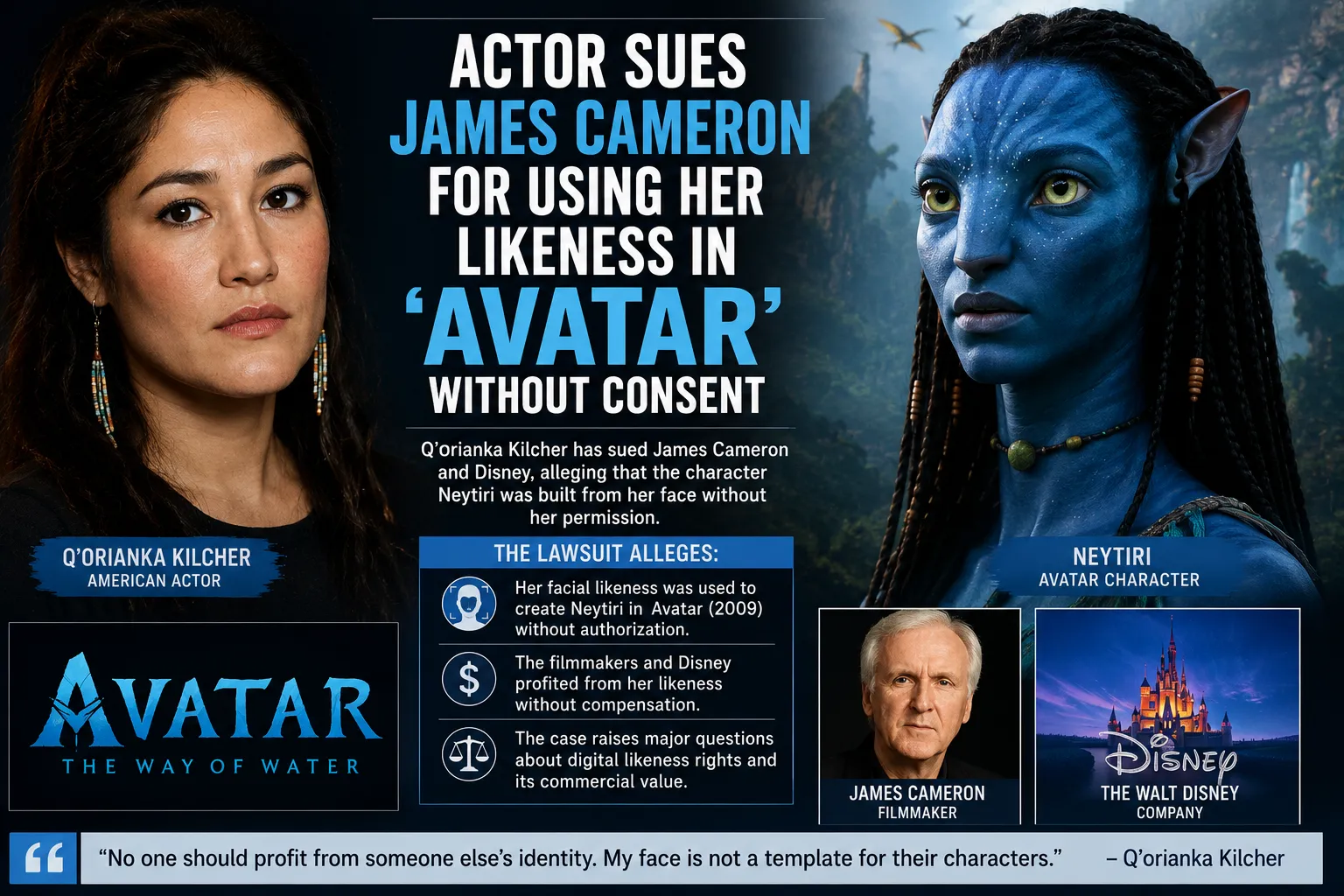
A new legal controversy involving one of Hollywood’s most successful film franchises has reignited debate over digital likeness rights, performer protections, and the growing power of visual effects technology in the entertainment industry. American actor Q’orianka Kilcher has reportedly filed a lawsuit against filmmaker James Cameron and entertainment giant The Walt Disney Company, alleging that the appearance of the character Neytiri in Avatar was modeled using her facial likeness without authorization or compensation.
The case has drawn significant public attention because it raises broader legal and ethical questions about ownership of identity in the age of advanced CGI, motion capture, and artificial intelligence-driven visual technology. At the center of the dispute lies an increasingly important issue in modern entertainment: who controls a performer’s face, image, and digital representation?
As Hollywood becomes more dependent on virtual production and photorealistic digital characters, the lawsuit may have implications extending far beyond a single film franchise.
The Allegations Against the Avatar Team
According to reports surrounding the lawsuit, Q’orianka Kilcher claims that the Na’vi character Neytiri — portrayed in the film by Zoe Saldana — was visually developed using features closely resembling her own appearance.
The actor reportedly alleges that her facial structure and likeness were used without her permission during the creative and production process behind the blockbuster science-fiction film.
Neytiri remains one of the most recognizable characters from the Avatar franchise and has become a major commercial and cultural symbol associated with the films.
The lawsuit reportedly seeks damages related to unauthorized commercial exploitation of likeness rights, arguing that a person’s facial identity carries both artistic and economic value.
Neither James Cameron nor Disney had publicly confirmed the allegations at the time the controversy gained attention, but the legal dispute has already triggered discussions across the entertainment and legal industries.
Why the Case Matters Beyond Hollywood
The controversy is not simply about one character design. Legal experts say the dispute touches upon a rapidly evolving area of law involving personality rights, image ownership, and digital identity.
Modern filmmaking technologies now allow studios to:
-
Create hyper-realistic digital humans
-
Alter actors’ appearances digitally
-
Reconstruct faces using CGI
-
Generate synthetic performances
-
Build characters inspired by real human features
As these capabilities expand, courts around the world are increasingly being asked to determine how much control individuals have over their facial likeness and digital representation.
The entertainment industry has historically dealt with disputes involving unauthorized use of celebrity images in advertisements or merchandising. However, digital filmmaking introduces far more complex questions because visual inspiration and artistic transformation are often subjective.
The Avatar lawsuit may therefore become an important test case in defining the boundaries between artistic creation and likeness appropriation.
The Growing Commercial Value of Facial Identity
In modern entertainment, an actor’s face is no longer just part of performance — it is intellectual and commercial property.
Studios spend millions building recognizable characters and visual identities tied to performers. Streaming platforms, gaming companies, advertising agencies, and virtual reality developers increasingly rely on digitally replicating human appearances.
Legal analysts say this has dramatically increased the financial importance of likeness rights.
Actors today often negotiate contracts involving:
-
Image rights
-
Digital reproduction permissions
-
Motion capture ownership
-
Voice replication rights
-
AI-generated performance restrictions
The issue has become even more urgent with the rise of artificial intelligence tools capable of generating realistic human faces and performances.
Many performers fear that studios may eventually recreate appearances digitally without needing the actor physically present.
The Role of Motion Capture in Avatar
James Cameron’s Avatar franchise is widely regarded as a landmark achievement in motion capture and visual effects technology.
The films combined live acting performances with advanced CGI systems to create the Na’vi characters of Pandora. Actors performed using motion capture suits and facial performance tracking technology, allowing digital artists to transform human performances into animated alien characters.
Although the Na’vi characters are fictional and heavily stylized, they still retain human emotional expressions and facial structures.
This overlap between human realism and digital transformation is precisely what makes likeness disputes legally complicated.
Experts note that even if a character is not an exact replica of a real person, claims may still arise if distinctive facial traits or visual similarities appear substantial enough to suggest unauthorized inspiration.
Hollywood’s Increasingly Complex Legal Landscape
The lawsuit arrives at a time when Hollywood is already confronting intense debate over digital identity rights.
Recent industry discussions have focused heavily on:
-
AI-generated actors
-
Deepfake technology
-
Digital resurrection of deceased performers
-
Synthetic voice cloning
-
Ownership of scanned performances
The issue became a major point of concern during recent labor disputes involving actors and writers in the American entertainment industry.
Performers expressed fears that studios could scan their faces and bodies once and reuse those digital assets indefinitely without fair compensation.
As technology advances, legal systems are struggling to keep pace with questions surrounding digital consent and virtual representation.
The case involving Avatar may therefore contribute to broader conversations already reshaping entertainment law.
The Challenge of Proving Likeness Claims
Lawsuits involving facial likeness are often difficult to prove because human features naturally overlap among individuals.
Courts typically examine several factors, including:
-
Degree of visual similarity
-
Evidence of intentional copying
-
Commercial benefit derived from the likeness
-
Public recognition of resemblance
-
Whether the use causes confusion or exploitation
In highly stylized films such as Avatar, determining whether a fictional character unlawfully resembles a real person becomes especially complicated.
Legal experts say the case could involve detailed forensic comparison of facial structures, design processes, concept art, and production records.
Studios often defend themselves by arguing that fictional characters are composites influenced by multiple artistic sources rather than direct copies of any individual.
The Economic Power of the Avatar Franchise
The legal attention surrounding the case is amplified by the enormous commercial success of the Avatar franchise.
James Cameron’s original Avatar became one of the highest-grossing films in cinematic history and revolutionized 3D filmmaking upon release.
Subsequent installments expanded the franchise into a global entertainment property spanning merchandise, streaming, gaming, and theme park attractions.
Characters like Neytiri therefore possess significant commercial value far beyond the films themselves.
If a court were to determine that an individual’s likeness contributed materially to such a profitable intellectual property, the financial implications could be substantial.
Artistic Inspiration Versus Unauthorized Use
One of the central questions raised by the lawsuit is where the line exists between artistic inspiration and unauthorized appropriation.
Artists and filmmakers frequently draw inspiration from real-world faces, cultures, and experiences when designing fictional characters.
However, critics argue that when a resemblance becomes commercially exploitable, ethical and legal concerns emerge.
The debate is becoming more urgent because digital technology now allows creators to reproduce human features with extraordinary accuracy.
Supporters of stronger likeness protections argue that individuals should maintain control over how their identity is used commercially, especially in billion-dollar franchises.
Others warn that overly broad restrictions could limit artistic freedom and create uncertainty for filmmakers and designers.
Broader Implications for the Entertainment Industry
The outcome of the lawsuit could influence how studios approach digital character development in the future.
Entertainment lawyers say production companies may increasingly adopt stricter safeguards, including:
-
More detailed likeness clearance procedures
-
Expanded performer contracts
-
Internal design documentation
-
Legal review of character modeling processes
Studios may also become more cautious when using facial references during digital design development.
The case could additionally affect industries beyond cinema, including:
-
Video game development
-
Virtual reality
-
Advertising
-
AI-generated media
-
Digital influencer creation
As digital humans become more realistic, legal systems worldwide may face growing pressure to modernize identity protection laws.
Public Reaction and Ethical Debate
Public reaction to the controversy has been divided.
Some observers believe performers deserve stronger legal protections as technology makes unauthorized replication increasingly possible.
Others argue that visual similarity alone should not automatically imply legal wrongdoing, especially in heavily fictionalized fantasy worlds.
The case has also revived concerns about how rapidly evolving technology may outpace ethical standards and regulatory frameworks.
Questions surrounding consent, ownership, and identity are likely to become even more important as AI and digital filmmaking continue advancing.
Conclusion
The lawsuit filed by Q’orianka Kilcher against James Cameron and over the alleged use of her likeness in Avatar has opened a major conversation about digital identity rights in modern entertainment.
At stake is more than the appearance of a fictional character. The case reflects a rapidly changing industry where technology can blur the boundaries between inspiration, replication, and ownership.
As CGI, motion capture, and artificial intelligence continue transforming filmmaking, courts and lawmakers may increasingly be required to define who controls the commercial use of human identity in virtual spaces.
Regardless of the eventual legal outcome, the controversy underscores a growing reality in contemporary entertainment: in the digital age, a face may carry not only artistic significance but also immense economic and legal value.
iodailynews.com iodailynews.com iodailynews.com iodailynews.com iodailynews.com iodailynews.com iodailynews.com iodailynews.com iodailynews.com iodailynews.com iodailynews.com iodailynews.com iodailynews.com iodailynews.com iodailynews.com iodailynews.com iodailynews.com iodailynews.com iodailynews.com iodailynews.com iodailynews.com iodailynews.com iodailynews.com iodailynews.com iodailynews.com iodailynews.com iodailynews.com iodailynews.com iodailynews.com iodailynews.com iodailynews.com iodailynews.com iodailynews.com iodailynews.com iodailynews.com iodailynews.com iodailynews.com iodailynews.com iodailynews.com iodailynews.com iodailynews.com iodailynews.com iodailynews.com iodailynews.com iodailynews.com iodailynews.com iodailynews.com iodailynews.com iodailynews.com iodailynews.com iodailynews.com iodailynews.com iodailynews.com iodailynews.com iodailynews.com iodailynews.com iodailynews.com iodailynews.com iodailynews.com iodailynews.com iodailynews.com iodailynews.com iodailynews.com iodailynews.com iodailynews.com iodailynews.com iodailynews.com iodailynews.com iodailynews.com iodailynews.com iodailynews.com iodailynews.com iodailynews.com iodailynews.com iodailynews.com iodailynews.com iodailynews.com iodailynews.com iodailynews.com iodailynews.com iodailynews.com iodailynews.com iodailynews.com iodailynews.com iodailynews.com iodailynews.com iodailynews.com iodailynews.com iodailynews.com iodailynews.com iodailynews.com iodailynews.com iodailynews.com iodailynews.com iodailynews.com iodailynews.com iodailynews.com iodailynews.com iodailynews.com iodailynews.com iodailynews.com iodailynews.com iodailynews.com iodailynews.com iodailynews.com iodailynews.com iodailynews.com iodailynews.com iodailynews.com iodailynews.com iodailynews.com iodailynews.com iodailynews.com iodailynews.com iodailynews.com iodailynews.com iodailynews.com iodailynews.com iodailynews.com iodailynews.com iodailynews.com iodailynews.com iodailynews.com iodailynews.com iodailynews.com iodailynews.com iodailynews.com iodailynews.com iodailynews.com iodailynews.com iodailynews.com iodailynews.com iodailynews.com iodailynews.com iodailynews.com iodailynews.com iodailynews.com iodailynews.com iodailynews.com iodailynews.com iodailynews.com iodailynews.com iodailynews.com iodailynews.com iodailynews.com iodailynews.com iodailynews.com iodailynews.com iodailynews.com iodailynews.com iodailynews.com iodailynews.com iodailynews.com iodailynews.com iodailynews.com iodailynews.com iodailynews.com iodailynews.com iodailynews.com iodailynews.com iodailynews.com iodailynews.com iodailynews.com iodailynews.com iodailynews.com iodailynews.com iodailynews.com
